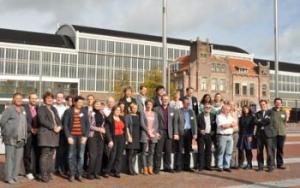
On October 4th 2012, the UDRIVE project (eUropean naturalistic Driving and Riding for Infrastructure & Vehicle safety and Environment) started with a two-day meeting in Haarlem (Netherlands). The nineteen partners, representing industry, research institutes, associations and universities, will work on the first large-scale European naturalistic driving study for the next 48 months.
 The UDRIVE project aims at obtaining an in-depth knowledge of driving and riding behaviour by conducting this large-scale European naturalistic driving study on cars, trucks and powered-two wheelers. UDRIVE grows on the experiences of the PROLOGUE feasibility study and the various Field Operational Tests (FOTs) projects such as TeleFOT, where CIDAUT is also participating.
Road transport is indispensable for the exchange of goods and persons, but at the same time has severe negative consequences, among others related to road safety and environment. In order to meet EU targets, both the number of road crashes and vehicle emission levels need to be reduced substantially. For identifying the next generation of measures that will enable us to actually reach these targets, a far more in-depth understanding of road user behaviour is needed.
Over a period of two years, UDRIVE will collect information on a total of 470 vehicles, each for one year: 240 passenger cars, 150 trucks, and 80 powered two-wheelers. All data will be collected continuously to bring knowledge in the research areas of crash causation factors & associated risks, distraction & fatigue, vulnerable road users, road infrastructure and eco-driving.
In particular, CIDAUT will conduct a one-year naturalistic riding study with 50 powered two-wheelers, contributing as well to the definition of the study design, the set-up and the data analysis.
 Henar Vega